Monday, 16 February 2015

Minoan Civilization

Minoan Civilization

References:

Minoan Civilization


"Aurochs - Bos Primigenius." The Sixth Extinction. N.p., n.d. Web. 16 Feb. 2015.

"Malia Minoan Palace & Archaeological Site, Malia, Crete Island, Greece." Malia Minoan Palace & Archaeological Site, Malia, Crete Island, Greece. N.p., n.d. Web. 16 Feb. 2015. resembles a modern day parisian, hence the name.      . 

Crete in the past was an island surrounded by myth and mystery. Rumours and legend told of a sophisticated society that inhabited the island thousands of years ago that was destroyed by geographical disasters. Archaeologists attempted to find traces of this past society, but many years passed before any evidence was found. Sir Arthur Evans was the first to discover the lost society. He uncovered a massive palace at Knossos that he claimed was the home of the mythical king Minos. Pottery that was decorated with bulls and depictions of gods was found scattered around the island. The famous society that had been lost for thousands of years had finally been found and named the 'Minoans'. The myth of Theseus and the minotaur takes place in Crete. The civilization is thought to have been destroyed by the resulting consequences of the volcanic eruption at Santorini, but recent evidence suggests otherwise.  

Flinders Petrie, one of Britain's leading Egyptian archaeologist in the 1900s, realized that the Aegean had much potential in terms of undiscovered ruins. Petrie had unearthed pottery fragments in Egypt. These pottery fragments were not of Egyptian origin and they dated three-hundred years before the tomb findings of Heinrich Schliemann. This created the assumption that an undiscovered civilization existed somewhere in the Aegean. The hunt to find the lost civilization that came before the Mycenaeans had just begun.  


The Minoan civilization had tried and perfected the act of breeding bulls. The result of the Minoan bull breeding led to the 'Aurochs' bull. The Aurochs bull was a wild cattle that inhabited regions, such as Europe, Asia and North Africa. The bull was massive, six-feet high at the shoulders with horns that could grow 80 centimetres in length. The Aurochs was known for being notoriously foul tempered.  


After the first traces of the Minoan civilization were unearthed on Crete several more excavations were undergone. These excavations took place all over the island and led to the discovery of pottery, palaces and many more ruins/objects. Some of these findings allowed people to understand the importance of bulls in the Minoan civilization. Many pieces of art and pottery were depicted with images of bulls, emphasizing the critical role that bulls had in the Minoan society. Minoan pottery depicting bulls soon became known as "kamares ware". Bulls were seen as sacred symbols and represented fertility. Religion was extremely important for the Minoans and many festivals were organized that evolved around 'bull leaping'. Certain individuals would grab onto the horns of a charging bull and leap over the beast before landing safely behind it. These festivals were the main form of entertainment in Crete. The 'bull leapers' were seen as heroic individuals and were praised. This crucial form of religious celebration and the people who took part is highlighted in many forms of Minoan society. Several forms of art and many types of pottery all depict and glamourize bull leaping. Minoan art is reflective of the socity' confidence, several pieces demonstrate that they would try any technique and use any material in order to create their pieces. One famous Minoan art piece, "La Parisienne", features a minion women. The women is considered the perfect Minoan and has a elegant and sophisticated aura around her. A visiting french scholar commented on how the depicted women in the artwork resembles a modern day parisian, hence the name.      

After the initial find of the palace at Knossos, many more archaeologists began hunting for more Minoan civilization sites. Through handwork and with time several more locations had been discovered, such as Phaistos and Malia. The palace of Malia was unearthed towards the east of Crete and is the third largest site that has been uncovered up to date. According to myth, the palace was inhabited by the brother of King Minos. The palace excavation yielded two unique finds. After the location of the royal burial centre was unearthed and searched a golden pendant depicting two bees was found. Also, a table was discovered inside the central courtyard, which archaeologists believe was used for sacrifices to the gods. 


Sunday, 15 February 2015

Alexander the Great

Alexander the Great

References:


Alexander the great is largely responsible for the spread of Hellenistic culture in various parts of the world. He was an incredible leader and conquered multiple regions, kingdoms and empires, such as the Persian Empire. Through the many conquests, Alexander had the ability to spread the Hellenistic culture by land and sea to all his newly acquired territories. Alexander either brought an influx of Hellenic related art or he created full cities that were shaped around the idea of Hellenic ideas. The most well known city which was created by Alexander is Alexandria, situated in Egypt. Bactria, known today as Afghanistan, was conquered in 329-327BC by Alexander and is a prime example of Hellenic conversion. Ruins exist throughout different regions of the country highlighting the presence of many hellenic buildings, such as a gymnasium.

After the death of Alexander his influence was still felt by many kingdoms. Rulers and the successors of Alexander wanted to be associated with the great ruler and therefore, they stole his image in various ways. Lysimachus, a general under Alexander, ruled Thrace after the death of his commander and minted silver coins in western Turkey (305-281BC). These coins portrayed Alexander the Great on one side and helped create the image that Lysimachus was his rightful successor.

One of the greatest cities in the ancient world: Alexandria

 Alexandria

References:

"Pharos of Alexandria | Ancient Lighthouse, Alexandria, Egypt." Encyclopedia Britannica Online. Encyclopedia Britannica, 7 Dec. 2014. Web. 12 Feb. 2015.

"Library of Alexandria | Ancient Library, Alexandria, Egypt." Encyclopedia Britannica Online. Encyclopedia Britannica, 17 Nov. 2014. Web. 11 Feb. 2015.

Dunn, Jimmy. "The Sarapeion, including Pompay's Pillar In Alexandria, Egypt." TourEgypt. N.p., n.d. Web. 12 Feb. 2015.


"Supreme Council of Antiquities - Sites." Supreme Council of Antiquities - Sites. N.p., n.d. Web. 15 Feb. 2015.


"Alexandria." Egyptian Monuments. N.p., 03 Mar. 2009. Web. 15 Feb. 2015.


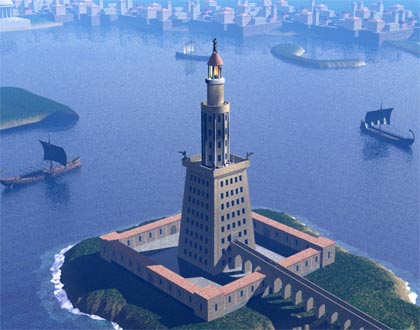
Alexandria is possibly the greatest metropolitan in the ancient world. The city's highly developed institutions and renowned architectural achievements rivaled Rome. Alexandria's wealth and marvels, such as the lighthouse and library made the city the envy of any empire.


The lighthouse of Alexandria (a.k.a. Pharos of Alexandria): Built by Sostratus of Cnidus and completed during the reign of Ptolemy II, 280BC. When finished the library was one of the tallest man made structures in the world. The library was considered one of the world's seven wonders.


The library was founded and maintained by the Ptolemy dynasty starting in the third century BC. The institution was renowned in the ancient world by scholars for being an incredible research and academic center.


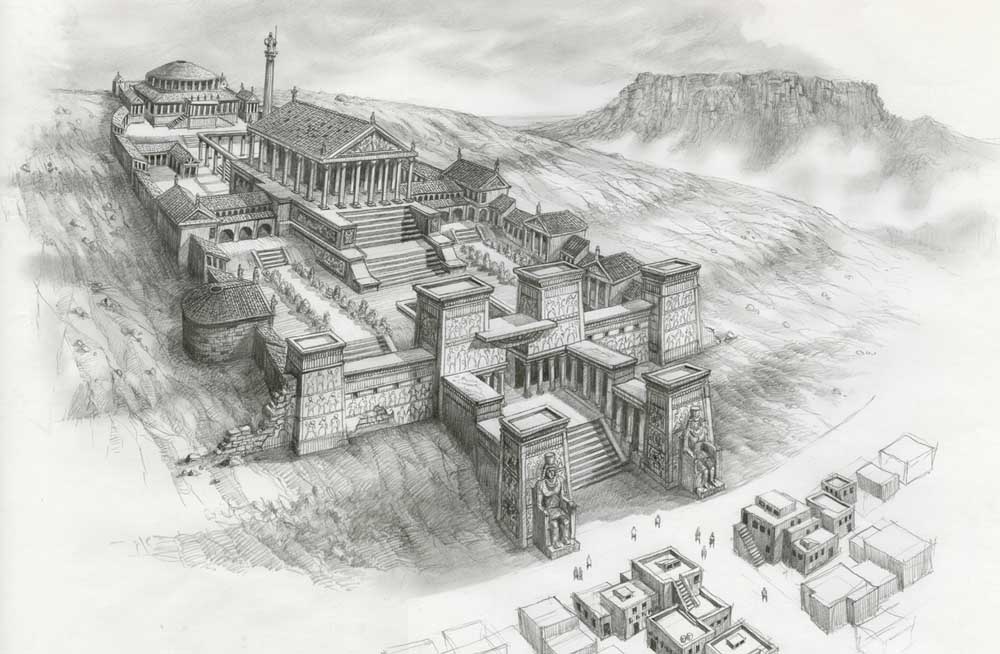
Ptolemy I invented 'Serapis' who was a new god introduced to Egypt that had both Greek and Egyptian origins. The Serapeum was dedicated to Serapis. The lone pillar is all that remains of where the mighty temple in honour to Serapis stood. The temple was eventually destroyed by the Christians.


Located in Anfushi, five tombs are closely situated. The tombs date from 1-200BC. The design of the tombs highlight the fusion of Egyptian and Greek culture.  


Located in the centre of Alexandria are the ruins of an old roman amphitheatre. The structure originally dates back to 200AD. The amphitheatre was used for entertainment, such as music and poetry. The building had a capacity to hold six hundred citizens. Unfortunately, the amphitheatre was destroyed by an earthquake (600-700AD).


Tuesday, 3 February 2015

Archaic Figure

References:


Peplos Kore

Created in 530BC and made of white marble. Found in Athens, Acropolis, West of the Erechtheum and now is located in the Acropolis museum.  


Friday, 30 January 2015

Mesopotamia – Egypt

Ramses II

References:


Egypt, Greece, and Rome. 73, 74, 76.  


Ramses II, King of Egypt around 1270BC. The British BroadCasting Corporation places immense importance on the Statue of Ramses II, made of granite and built in 1250BC. Ramses' statue was the largest Egyptian sculpture the british had ever seen, but more importantly it made the english realize how accomplished the Egyptians were. The statue emphasizes the extremely sophisticated culture of Egypt. The system of logistics and engineering needed to create a statue of this proportion at that time is an incredible achievement for the Egyptian civilization. The original piece of stone was carved out in one massive block and would have weighted around twenty tonnes. The stone would have needed a huge workforce to transport it to the Nile and then have it sailed to the city where the final details would be done. In 1798, the french tried to remove the statue during their control of Egypt, but failed and damaged it in their attempt. In 1816, half the statue was successfully removed by Giovanni Battista Belzoni. Mr. Belzoni used a method almost identical to the Egyptian method that transported the statue to its original location. The difficulty of moving only half the statue 3000 years after it had been placed demonstrates the immense achievement of the Egyptian people. The statue was transported to Cairo and then travelled to London. The statue was the first piece of ancient Egyptian work that challenged the idea that great art had began in Greece.

Ramses II is briefly covered in the text book: Egypt, Greece, and Rome because he did not expand the Egyptian borders. Ramses attempted to increase the territory of Egypt, but realized that he could not. His few battles were presented to his people as major victories, but in reality they were stalemates. As a result, Ramses II focused on building projects to glorify himself since he could not add splendour to his name through conquests.

Mesopotamia – Egypt

The Rosetta Stone

References:

Romancing the Stone, History Today. May, 2006


In February 1802, Colonel Turner sailed into Portsmouth harbour on the captured french ship HMS 'L'Egyptienne'. Colonel Turner had in his possession the Rosetta stone, what he claimed was a prize of war captured from the french that had the potential to unlock the mysterious language of hieroglyphics. The facts of how Britain really acquired the stone remain a mystery. Colonel Turner claimed it was a prize of war, but Edward Clarke, a famous scholar who was in Alexandria after the french surrender, claims the stone was peacefully handed to the British. Oddly, a list that described artifacts recovered by the British after the french surrender states that the stone was "loaded onto HMS Madras" (History Today).

In 1799, the stone was discovered on the West bank of the Nile in the port of Rashid by french soldiers. The stone was dated to the reign of Ptolemy V, 196BC. After Napoleon left Egypt, the 167 remaining scholars, scientists and other professionals formed the 'Institut d'Egypte' in 1798. This institute focused on the studies of ancient Egypt and revealing her secrets, the Rosetta Stone came into the possession of this organization. In 1801, after the french surrender and transfer of artifacts to the british the english crown profited largely from all the previously done french research. The British Broadcasting Corporation does not mention any of the progress that the French made before they surrendered in 1801. The podcast highlights how Thomas Young made the first key step of cracking the code by discovering the name of Ptolemy V inside the inscriptions. Later, the podcast mentions how Jean Francois Champollion worked off the progress of Young and realized the language was both pictorial and phonetic. In 1822, Champollion had cracked the code of hieroglyphics.

Mesopotamia – Egypt

Royal Tombs of Ur

References:

Zettler, R.L., and Horne, L., eds.
1998  Treasures from the Royal Tombs of Ur. Philadelphia:
 University of Pennsylvania Museum.


The podcast presented by the British Broadcasting Corporation covers the foundation of how Mesopotamian cities were created. Ur is one of the earliest and most famous of these ancient cities. Leonard Woolley in the 1920s uncovered royal tombs at Ur. Objects such as, golden headdresses and the earliest known board game were found in these tombs, amongst other treasures. A mysterious 'plaque' was the highlight of Woolley's discovering, which was a very detailed piece of art demonstrating power in these ancient Mesopotamian cities. Woolley named this object the "Standard of Ur" assuming that this plaque was an ancient battle standard. Nowadays, archaeologists have considered that the object is not a battle standard as a result of the object's inscriptions needing close examination to be read. The true use for this marvel is unknown. The podcast examines how only the bitumen used to hold the Standard together would have been found locally. All other material used to construct the piece of art would have been imported from around several regions. This fact points to the idea that only a wealthy/powerful society could have created such an object. The Standard depicts two different scenes. One side demonstrating how an ideal tax system would work. The other side highlighting an army being led by the mighty king. The BBC highlights how the Mesopotamian past is a key unifying piece for Iraq's future.

In 1994, the University of Pennsylvania Museum created an exhibition that would evolve around the discoveries that Woolley made at Ur. The american article describes the early civilization of Ur and the period where Ur would have been at its climax of power. Nanna, the moon God who was primarily worshipped at Ur is mentioned briefly. Also, the article mentions how the region at the time would have been divided into several small regions/towns. Ur's importance is evident in the high amounts of foreign goods located inside the city. The article explains how the University of Pennsylvania and the British Museum to Ur worked together and decided to have Woolley head the expedition. During the excavation Woolley had two "trial trenches". One trench revealed a cemetery area, which led to the discovering of the royal tombs. The other trench unearthed spectacular architectural pieces. Woolley during the first season of excavation focused on trial trench B that had revealed architectural remains. He felt that his workforce was inadequately prepared for the challenge of excavating burial sites. Woolley only began to give trial trench A (cemetery site) his attention in his fifth season of excavation. Hundreds of burials were discovered in less than three months, amongst these tombs were sixteen royal tombs. Woolley closed his excavations after twelve seasons on February 25th, 1934.