Tuesday, 17 March 2015

Museum Visit & Field Trip


Museum Visit

References:

Montreal museum vist.

Museums Readings. Posted on LEA.


Prep Questions Before Visit (First Floor)

Cycladic figures: Excavation in 2006, more than 200 figurines were unearthed. All figurines had "ritually" been broken into 4 pieces and then brought to Keros for "deposition".

Frying Pan: zoomorphic form; terracotta hedgehogs. Shows both humour and naturalism.

Kamares Ware One of the more popular themes for Kamares ware is the 'beak-spouted' jug.

Mycenaean funerary masks: The ceremonial daggers found in the Mycenaean grave circles depict scenes of hunting, lions and 'river life'.

Geometric pottery: Mourners on the geometric pot are tearing at their hair and signing laments.

Mycenaean swords: Type C Mycenaean swords are also referred to as 'horned swords'.

Labrys: Females are generally associated with Labrys in the Minoan religious culture.

Museum Work:

Mycenae:
-Athens. daggers. National Archaeological Museum. 16th century (second half) BC.
-Chania. Mirror/knife. 1450-1500BCE.
-Athens. Cup. National Archaeological Museum. 16th century (second half) BC.

Marble: Naxos created and was known for great marble. The island of Paros was also known for their wonderful marble.

Script: The words in Linear B translated into the mentioning of greek gods/goddesses, olive oil and man/female.

Bronze: Tin and copper are gathered together and melted. Once the metals are melted they are poured into a hardened clay mold. When the metals have cooled the clay mold is removed.

Sources: Most of the sources are from 'Wikipedia'. This is surprising because Wikipedia sources are not reliable. The museum sources should have originated from peer reviewed scholarly works that were published by professionals in the field.

Helmets: The war helmets had been constructed out of copper. This meant that over time they turned green as a result of oxidization.

Prep Questions Before Visit (Second Floor)

A) Ivory was the material used to create the figurines spoken of in the article. This is surprising because ivory was a rare material that was imported from Egypt and Syria. Also, the material eventually disappeared from the market after the Late Bronze Age.

B) The mountain sanctuary discussed by Pausanias is Ptoan Apollo.

Museum Work:

Statue: "The Princess of the Mediterranean" speaks about a grave of a women being found with several female ivory figurines in her tomb. The tomb of this wealthy women might be associated with the Lady of Archotiko.

This is Sparta:  Spartan hoplite statue dates to the second quarter of the 5th century BCE. The creation of the statue falls roughly 10 years after the battle of Marathon.

Alexander the Great: The archaeological remains are majestic and beautifully done. The pieces highlight and demonstrate the power that Alexander held and his glorious achievements.

--------------------------------------------------------------------------------------------------------------------------

Masonic Temple

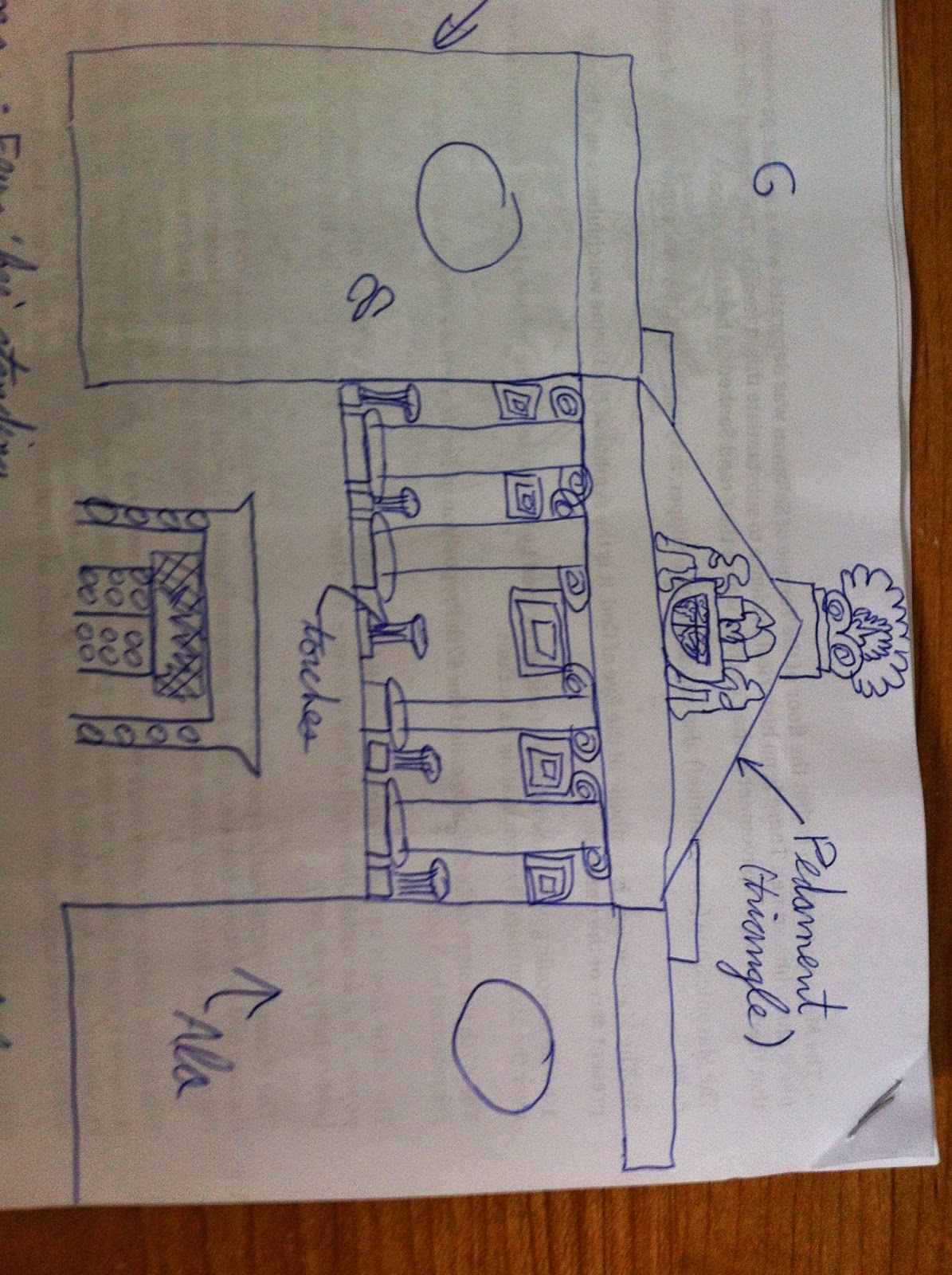
The Masonic lodge is an interesting building because it has elements of both Greek and Roman architecture. The building appears to be constructed out of limestone. The Masonic lodge shows evidence of a Roman 'Maison Carrée'. The architecture of this building like the Romans has only a few 'engaged columns'. These engaged columns create the illusion of a 'peripteral temple'. This differs from the Greeks who designed their temples to be surrounded by 'stylobates'. Also, the Masonic structure was designed with an extending wing to the left and right. These two extra wings, 'alae', link the Masonic building to Roman architectural designs.

In addition, The Masonic lodge has several Greek aspects. The columns used in the structure are designed in ionic fashion. The flat edge between the channels demonstrates Ionic 'fluting'.  Also, the entrance of the building has several rossettes around the door. Near the structure' columns we can see two features that highlight Greek influence. Between the ionic columns we can see torches that are designed with a tripod stand holding the piece where the flame would be found. Above the torches, built into the wall between the columns are five squares designed in a way that appears to make them look 'wavy'. This design hints towards a Minoan/bronze age influence. Also, the 'entablature' of the building has another Greek element. The Masonic lodge ties into Greek architecture because it has a 'pediment'. The Parthenon, ancient Greece's greatest temple, has pediments designed into the structure too.

Lastly, the Masonic lodge holds architectural elements that are neither Greek nor Roman. When studying the different elements of the structure you will notice that at the highest point of the building is located an etruscan 'acroteria'. The acroteria was an architectural design that Etruscans implemented on their early temples.


Acroteria:


Masonic Lodge:


Tuesday, 10 March 2015

Greek Pottery


Greek Pottery

References:

American Journal of Archaeology, Vol. 113, No. 4 (Oct., 2009), pp. 599-627 


Greek vase painting has for many years held an important role in the topic of classical archaeology. The focus of analysis on Greek painted ceramics began in the 18th century. Scholars slightly disagree on some aspects of Greek vase painting.  One area that all professionals support is the importance of vases from the Archaic and Classical periods. Most reports made by scholars on Greek vase painting are collected and published every couple of years in the Bulletin Archeologique: Ceramique of the Revue des Etudes Grecques. This essential academic  resource was founded by Henri Metzger in 1960. Most publications highlighting Greek ceramics are the excavations reports created by professionals in the field. These reports either discuss specific finds at a certain location or go into extreme detail on entire sites. Excavation reports allow for a short overview of a specific type of pottery found on location. Also, the reports aide in comprehending individual artists and the importance certain ceramics had at a specific site. Sadly, excavation reports do not publish information regarding other materials found around the ceramics. This creates a situation that does not allow scholars to understand the context that ceramics fall under. Nowadays, professionals as a standard have began to report the ceramics within their contexts. This new standard may be seen with the publication of two volumes from the Kerameikos excavations: "Kunze-Gotte's study of archaic and classical graves and Knigge's publication of Bau Z". Some countries, such and the United States and Germany do not fully appreciate the study of Greek ceramics. Many American professionals only focus on the concept of studying pottery, but not excavating the vases. This poses a problem considering that pottery is the "most common artifact" unearthed during excavations. The Archaeology Institute of America's Code of Professional Standards, amongst other organizations, pressure archaeologists to publish their findings within a reasonable time, but many professionals do not abide by these standards. Conferences focused around Greek ceramics are a relatively new idea. The University of Amsterdam's "Ancient Greek and Related Pottery" conference in 1984 was a major step for international attention on the topic of Greek ceramics. A catalogue that was created specifically for ancient vases is the Corpus Vasorum Antiquorum. The catalogue was established in 1919 by Edmond Pottier, "who published the first volume of the series in 1923". Today, many of the catalogues focus on Greek painted pottery, especially all black/red figure types. The Germans compared to the other 26 countries who take part in the catalogue have produced the most editions, 84 copies out of the 325 are credited to them. Greek painted ceramics/pottery is a key component in several classical exhibitions. This has caused "major exhibits" in which Greek ceramics have had a crucial role, such as the several exhibitions that were created "in response to the 2004 Olympic Games in Athens...".           

During the 19th century, scholars started to attempt linking ceramics with the specific artists who created them. At first, professionals used signed vases as an early point of reference. Unfortunately, this created a situation that did not allow unsigned vases to be link to any artist. Sir John Davidson Beazley did groundbreaking work in associating unsigned ceramics with specific artist. He devoted many years to this research and was able to credit several unsigned Athenian ceramics. Sir John was able to link ceramics to specific artists based on the style of drawing. This allowed for a better analysis of how Attic black figure and red figure ceramics developed. This new understanding enabled for the dating of figured pottery and is still used today. The concept provides professionals the ability to trace ceramics back to the workshop of origin. Thus, Beazley's research allows for scholars to be able determine several elements about the past, such as trade routes. 

Monday, 16 February 2015

Minoan Civilization

Minoan Civilization

References:

Minoan Civilization


"Aurochs - Bos Primigenius." The Sixth Extinction. N.p., n.d. Web. 16 Feb. 2015.

"Malia Minoan Palace & Archaeological Site, Malia, Crete Island, Greece." Malia Minoan Palace & Archaeological Site, Malia, Crete Island, Greece. N.p., n.d. Web. 16 Feb. 2015. resembles a modern day parisian, hence the name.      . 

Crete in the past was an island surrounded by myth and mystery. Rumours and legend told of a sophisticated society that inhabited the island thousands of years ago that was destroyed by geographical disasters. Archaeologists attempted to find traces of this past society, but many years passed before any evidence was found. Sir Arthur Evans was the first to discover the lost society. He uncovered a massive palace at Knossos that he claimed was the home of the mythical king Minos. Pottery that was decorated with bulls and depictions of gods was found scattered around the island. The famous society that had been lost for thousands of years had finally been found and named the 'Minoans'. The myth of Theseus and the minotaur takes place in Crete. The civilization is thought to have been destroyed by the resulting consequences of the volcanic eruption at Santorini, but recent evidence suggests otherwise.  

Flinders Petrie, one of Britain's leading Egyptian archaeologist in the 1900s, realized that the Aegean had much potential in terms of undiscovered ruins. Petrie had unearthed pottery fragments in Egypt. These pottery fragments were not of Egyptian origin and they dated three-hundred years before the tomb findings of Heinrich Schliemann. This created the assumption that an undiscovered civilization existed somewhere in the Aegean. The hunt to find the lost civilization that came before the Mycenaeans had just begun.  


The Minoan civilization had tried and perfected the act of breeding bulls. The result of the Minoan bull breeding led to the 'Aurochs' bull. The Aurochs bull was a wild cattle that inhabited regions, such as Europe, Asia and North Africa. The bull was massive, six-feet high at the shoulders with horns that could grow 80 centimetres in length. The Aurochs was known for being notoriously foul tempered.  


After the first traces of the Minoan civilization were unearthed on Crete several more excavations were undergone. These excavations took place all over the island and led to the discovery of pottery, palaces and many more ruins/objects. Some of these findings allowed people to understand the importance of bulls in the Minoan civilization. Many pieces of art and pottery were depicted with images of bulls, emphasizing the critical role that bulls had in the Minoan society. Minoan pottery depicting bulls soon became known as "kamares ware". Bulls were seen as sacred symbols and represented fertility. Religion was extremely important for the Minoans and many festivals were organized that evolved around 'bull leaping'. Certain individuals would grab onto the horns of a charging bull and leap over the beast before landing safely behind it. These festivals were the main form of entertainment in Crete. The 'bull leapers' were seen as heroic individuals and were praised. This crucial form of religious celebration and the people who took part is highlighted in many forms of Minoan society. Several forms of art and many types of pottery all depict and glamourize bull leaping. Minoan art is reflective of the socity' confidence, several pieces demonstrate that they would try any technique and use any material in order to create their pieces. One famous Minoan art piece, "La Parisienne", features a minion women. The women is considered the perfect Minoan and has a elegant and sophisticated aura around her. A visiting french scholar commented on how the depicted women in the artwork resembles a modern day parisian, hence the name.      

After the initial find of the palace at Knossos, many more archaeologists began hunting for more Minoan civilization sites. Through handwork and with time several more locations had been discovered, such as Phaistos and Malia. The palace of Malia was unearthed towards the east of Crete and is the third largest site that has been uncovered up to date. According to myth, the palace was inhabited by the brother of King Minos. The palace excavation yielded two unique finds. After the location of the royal burial centre was unearthed and searched a golden pendant depicting two bees was found. Also, a table was discovered inside the central courtyard, which archaeologists believe was used for sacrifices to the gods. 


Sunday, 15 February 2015

Alexander the Great

Alexander the Great

References:


Alexander the great is largely responsible for the spread of Hellenistic culture in various parts of the world. He was an incredible leader and conquered multiple regions, kingdoms and empires, such as the Persian Empire. Through the many conquests, Alexander had the ability to spread the Hellenistic culture by land and sea to all his newly acquired territories. Alexander either brought an influx of Hellenic related art or he created full cities that were shaped around the idea of Hellenic ideas. The most well known city which was created by Alexander is Alexandria, situated in Egypt. Bactria, known today as Afghanistan, was conquered in 329-327BC by Alexander and is a prime example of Hellenic conversion. Ruins exist throughout different regions of the country highlighting the presence of many hellenic buildings, such as a gymnasium.

After the death of Alexander his influence was still felt by many kingdoms. Rulers and the successors of Alexander wanted to be associated with the great ruler and therefore, they stole his image in various ways. Lysimachus, a general under Alexander, ruled Thrace after the death of his commander and minted silver coins in western Turkey (305-281BC). These coins portrayed Alexander the Great on one side and helped create the image that Lysimachus was his rightful successor.

One of the greatest cities in the ancient world: Alexandria

 Alexandria

References:

"Pharos of Alexandria | Ancient Lighthouse, Alexandria, Egypt." Encyclopedia Britannica Online. Encyclopedia Britannica, 7 Dec. 2014. Web. 12 Feb. 2015.

"Library of Alexandria | Ancient Library, Alexandria, Egypt." Encyclopedia Britannica Online. Encyclopedia Britannica, 17 Nov. 2014. Web. 11 Feb. 2015.

Dunn, Jimmy. "The Sarapeion, including Pompay's Pillar In Alexandria, Egypt." TourEgypt. N.p., n.d. Web. 12 Feb. 2015.


"Supreme Council of Antiquities - Sites." Supreme Council of Antiquities - Sites. N.p., n.d. Web. 15 Feb. 2015.


"Alexandria." Egyptian Monuments. N.p., 03 Mar. 2009. Web. 15 Feb. 2015.


Alexandria is possibly the greatest metropolitan in the ancient world. The city's highly developed institutions and renowned architectural achievements rivaled Rome. Alexandria's wealth and marvels, such as the lighthouse and library made the city the envy of any empire.


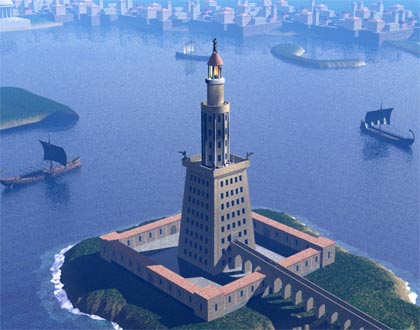
The lighthouse of Alexandria (a.k.a. Pharos of Alexandria): Built by Sostratus of Cnidus and completed during the reign of Ptolemy II, 280BC. When finished the library was one of the tallest man made structures in the world. The library was considered one of the world's seven wonders.


The library was founded and maintained by the Ptolemy dynasty starting in the third century BC. The institution was renowned in the ancient world by scholars for being an incredible research and academic center.


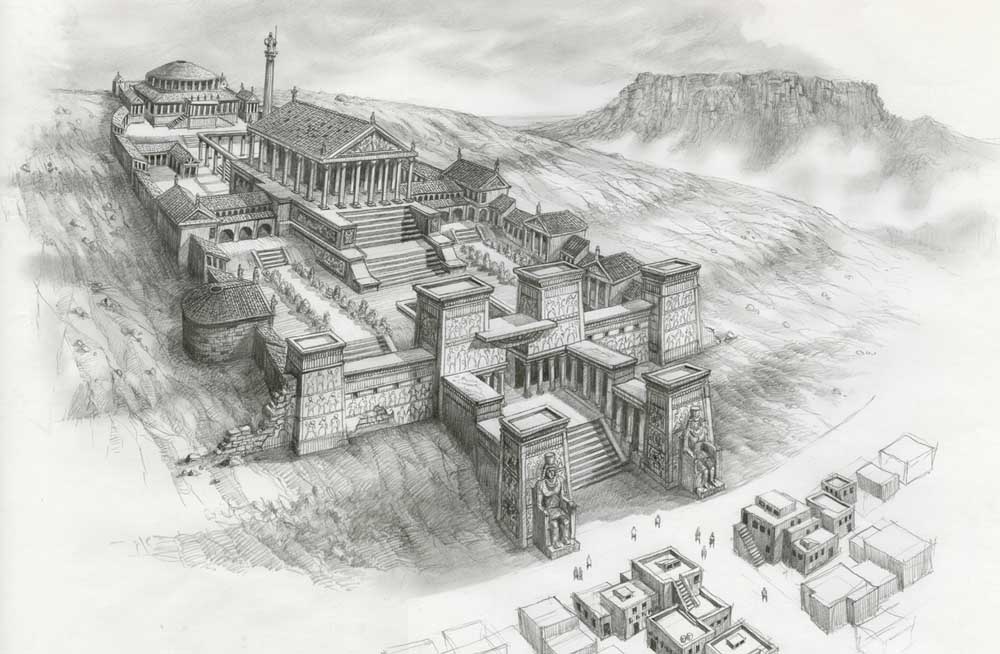
Ptolemy I invented 'Serapis' who was a new god introduced to Egypt that had both Greek and Egyptian origins. The Serapeum was dedicated to Serapis. The lone pillar is all that remains of where the mighty temple in honour to Serapis stood. The temple was eventually destroyed by the Christians.


Located in Anfushi, five tombs are closely situated. The tombs date from 1-200BC. The design of the tombs highlight the fusion of Egyptian and Greek culture.  


Located in the centre of Alexandria are the ruins of an old roman amphitheatre. The structure originally dates back to 200AD. The amphitheatre was used for entertainment, such as music and poetry. The building had a capacity to hold six hundred citizens. Unfortunately, the amphitheatre was destroyed by an earthquake (600-700AD).


Tuesday, 3 February 2015

Archaic Figure

References:


Peplos Kore

Created in 530BC and made of white marble. Found in Athens, Acropolis, West of the Erechtheum and now is located in the Acropolis museum.